| Charity No: 1197240
Sharing online can reveal more personal information than we realise, from school logos and location clues to everyday routines. This blog introduces the simple “letterbox test” to help parents and children think twice before posting, recognise hidden details in photos and make more informed choices about their digital privacy. With practical tips and a reassuring approach, it encourages families to build safer online habits without giving up the joy of sharing.

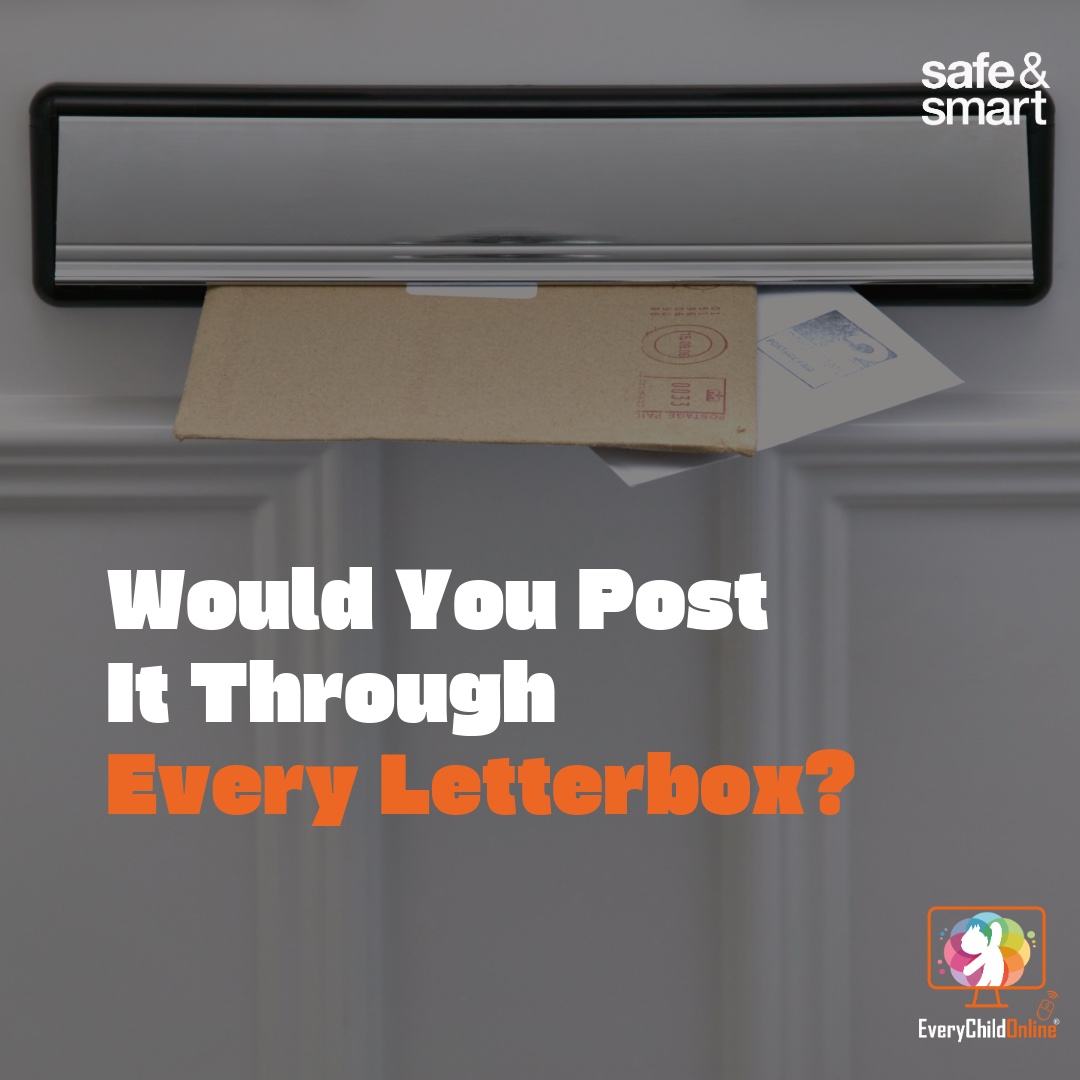
Would You Post It Through Every Letterbox?
Helping children understand what they give away online
Most children know there are some things they should not share online:
So far, so good.
But online privacy is rarely lost in one dramatic moment. It is usually not a child typing, “Hello internet, here is my full identity and a map of my life.”
It is the school logo in the corner of a photo. A birthday badge. A sports club hoodie. A street sign in the background. A countdown to a family holiday. A pet’s name that also happens to be doing quite a lot of work as a password hint.
Individually, these things look harmless. Together, they can build more of a picture than we realise.
And children are not the only ones sharing them.
Parents do it too.
We post the first day of school photo. The dance certificate. The football fixture. The holiday snap. The “look how grown up they are” birthday post.
We do it because we are proud of them. Because family sometimes live far away. Because a moment is funny or moving or joyful. Because children are a big part of our lives, and it feels strange to pretend they are not.
Most of the time, we are not trying to broadcast our children’s lives to the world but online audiences are not always as tidy as we imagine. Posts can be saved, screenshotted, forwarded, reshared, or seen by more people than we expected.
This does not mean parents should panic, delete every photo, move to a cabin and communicate only by carrier pigeon. Though, admittedly, the pigeon would have excellent data minimisation habits.
It just means we need a better pause button.
The letterbox test
One of the simplest ways to explain online privacy to children is to take it offline.
Ask:
Would you print this out and put it through every letterbox on your street?
Not because every online post will be seen by everyone. It probably will not. But because the letterbox test helps children imagine an audience they cannot see.
Would they put a photo of themselves through every door in the neighbourhood with a note saying:
“This is me. This is where I go to school. These are the things that I am interested in.”
Probably not.
Would they send a postcard to strangers in the next town saying:
“We are off on holiday tomorrow and our house will be empty for two weeks.”
Again, probably not.
Yet online, the same information can travel in ways we do not always notice. A photo here, a caption there, a tag somewhere else. Someone saves it. Someone forwards it. Someone posts it in a group chat. Nobody meant to share too much. It just moved beyond the audience we had in mind.
The problem is not sharing. It is sharing without noticing.
Personal information is not always obvious
When adults say “don’t share personal information,” kids will often think we mean the big things: address, phone number, full name, password.
That is a good start. But personal information can also be ordinary-looking details, such as:
This is not about scaring children (or parents). It is about helping kids develop the same instincts online that we already teach offline.
We do not say, “Never leave the house.” We teach them how to cross the road. We do not say, “Never speak to another human.” We teach them how to recognise safer and less safe situations.
Online privacy is similar. The goal isn’t to ignore the online world. It is awareness of the risks.
Children learn from our pause
One of the easiest ways to teach this is to model it.
Many children have an online presence before they can walk, talk, or object to being photographed wearing a pumpkin costume.
We’re the first generation of parents navigating a digital age, with a camera roll full of love and very little fine print.
But children notice how adults share too. If we pause before posting, check the background, or ask before sharing a photo, we are showing them what thoughtful sharing looks like.
That does not mean never posting about them. Families will make different choices, each right for them. But if they are of an age where they can understand, we can ask simple questions out loud:
Some parents may smile at the idea of asking, especially if their own parents were not exactly running household decisions past them. But those little conversations matter. They tell children: your image belongs to you. Your feelings matter. You get a say in how people use it.
That is exactly the message we want them to carry into their own online lives as they grow into teens and adults.
Look behind the smile
Children tend to focus on the main thing in a photo: their face, their outfit, their dog proudly presenting a stolen sock.
But the background matters too.
A bedroom photo might show school books, certificates, medicine, devices, other pictures, family names or a view from the window. A doorstep photo might show a house number. A car photo might show a registration plate.
So before posting, teach one simple habit:
Look behind the smile.
Check the edges of the photo. Look at the wall, the table, the badge, the envelope, the screen, the reflection.
You do not have to stop sharing. You just have to see everything you are sharing.
Three questions before posting
For parents and children, a useful pause can be as simple as three questions.
1. Who could see this?
Not just who you want to see it. Who could see it if it was shared, saved, screenshotted or forwarded?
2. What does it reveal?
Does it show a school, club, location, routine, full name, age, friendship group or private space?
3. How might it feel later?
Could this embarrass, upset or expose someone in a way they would not choose? Would I feel differently about it tomorrow, next year, or if it turned up somewhere unexpected?
These questions are not designed to stop every post. They are designed to create a pause, which is often enough.
Maybe you still post it. Maybe you crop it. Maybe you blur the badge. Maybe you send it privately instead. Maybe you decide the moment does not need a wider audience.
All of those are choices. That is the point.
Privacy is not secrecy
Privacy is being selective. It is knowing that not every audience needs every detail. It is understanding that a photo can say more than its caption. It is learning that sharing online should be a choice, not a reflex.
There is plenty about the online world that feels too big for families to control: platforms, algorithms, group chats, gaming communities, apps that appear overnight and are apparently essential to social survival by breakfast.
But some habits are simple.
Pause before posting. Check the background. Consider who may see it. Ask children before sharing about them. Teach them to spot the clues.
These habits will not solve every online risk. Nothing does. But they give children something valuable: a little more control over how much of themselves they give away, and a little more confidence about how they move through online spaces.
A good place to start that conversation is with the letterbox test.
Would you post it through every letterbox on your street?
If not, it might be worth one more look before posting.
Looking for help with a device? Please note that Every Child Online does not provide devices directly to members of the public. *
We’d love to hear from you! Whether you’re interested in partnering with us, making a donation, or simply want to learn more about our work, please get in touch using the form.
*Every Child Online operates within the UK only. We provide support through trusted referral partners, including schools, charities, social services and community organisations. We do not supply devices directly to members of the public or outside the UK.