| Charity No: 1197240
Polly Tarbard unpacks the UK's Online Safety Act and asks whether sweeping new age verification rules genuinely protect children, or come at the cost of privacy, free expression and access to important knowledge.
By Polly Tarbard, Every Child Online Safe & Smart Online Blogger.
The UK's communications regulator Ofcom has been tasked with enforcing new rules that require websites and apps to implement measures protecting children, or face hefty penalties ( up to £18 million or 10% of a company's global turnover for non-compliance). These new measures should prevent under-18s from accessing explicit content online; this includes filtering out harmful content and verifying user ages on services that host explicit material.
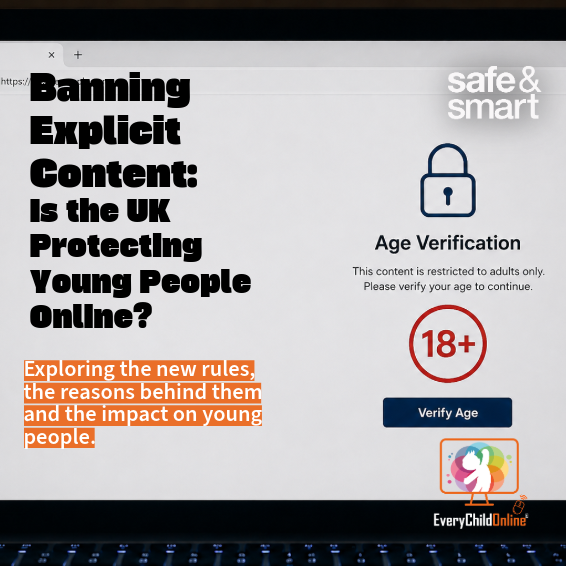
If an internet service hosts sexually explicit or other age-restricted content, it must implement age verification or age-assurance measures to ensure minors cannot view it. Under the Act, simply having a "18+" disclaimer or ticking a box to claim you are over 18 is no longer sufficient. Adult content websites should display a virtual ID check when the website is initially opened. These checks can be completed in various ways such as verifying credit card details, scanning an official ID document or using facial age estimation to confirm a user's age.
It is not just sexually explicit content that is being restricted - material classed as "primary priority" harmful content must also be kept away from children. This includes content that encourages suicide, self-harm, eating disorders, or other dangerous behaviours. Platforms are required to adapt their algorithms and features to protect younger users, meaning recommendation systems should actively filter out harmful or age-inappropriate material. They must also have clear procedures in place to remove or hide dangerous content quickly, while giving children simple tools to report anything that makes them feel unsafe. Ofcom's codes further specify that strangers should not be able to contact minors directly; platforms are expected to block adults from initiating private messages with children and to prevent unknown contacts from being suggested in the first place.
The motivation for this is largely centred around worries for children accessing pornography. Parents in the UK have ranked exposure to online pornography as one of their top concerns regarding their children's internet use. Parenting and education organisations have called for stricter age-gates and better education to to protect their children . A survey by the National Association of Head Teachers noted that many parents believe schools should start teaching children about the dangers of pornography as soon as they are old enough to use the internet, highlighting a huge concern among parents, who feel that conversations about pornography and its risks cannot be left until later in adolescence. These concerns are highly justified. Research by the Children's Commissioner for England found that children who first saw pornography at or below age 11 tended to have lower self-esteem as young adults. The problem does not just stop at confidence; extreme online content is cited as a factor in rising anxiety, body image issues, and compulsive behaviours among teens (with some even seeking therapy for porn addiction or trauma). Both these issues show that the problem is not simply about children being "too young" to see explicit material, its also about the lasting impacts the content can have on their development and wellbeing.
Beyond mental health, research also indicates pornographic content can foster unhealthy attitudes. Much of the content contains violent or degrading sexual acts - in fact, one UK analysis found 88% of popular porn scenes contained physical aggression (94% of which was directed at women). Concerningly, it was found that 44% of boys ages 11–16 who regularly viewed pornography said it gave them ideas about the types of sex acts they wanted to try (acts which often mirrored aggressive or unrealistic scenarios). Too much exposure to this kind of content can cause viewers to believe that this behaviour is normal or even expected in real life. Teen viewers can internalise these messages, coming to view women as sex objects and showing less empathy, which over time can normalise harmful gender stereotypes, make abusive behaviour seem acceptable, and shape attitudes that undermine respect, consent, and equality in real-world interactions.
Figures like these explain why the current ease of access to adult content has become such a pressing issue for parents and child safety organisations. Barnardo's, one of the UK's largest children's charities have warned that many children don't go looking for pornography at all; they stumble across it by accident, sometimes as early as primary school age, via innocuous web searches, unsolicited links, pop-up ads, or friends' phones. Ofcom's surveys found huge numbers of minors routinely encountering inappropriate content: in the last month alone, 16% of UK teenagers had seen material promoting eating disorders or stigmatising body types. When harmful material is this easy to come across, it raises the question of whether simply relying on parents and schools is enough to keep young people safe. Therefore for many parents, teachers and those concerned about the welfare of children, it is easy to support this new ban.
For parents, the Online Safety Act can feel like a welcome safety net, however it is not a substitute for parental guidance. While the new rules indeed make it much harder for children to stumble across adult sites, families still play the most important roles in shaping healthy digital habits. Parents can start by having open, age-appropriate conversations about why certain sites are blocked and what risks exist online. Using parental controls on devices and home Wi-Fi, setting boundaries around screen use (like no phones in bedrooms at night), and encouraging offline hobbies all help balance a child's relationship with technology. Most importantly, talking regularly about online experiences (both positive and negative) helps children feel able to share if they see something worrying. In this way, the Act works best as part of a broader toolkit, where legal safeguards, school support, and family involvement come together to keep children safe.
While many hail the Act as a step forward for child safety, many critics raise serious questions about privacy, free expression, and whether platforms will end up censoring more than necessary. Early evidence suggests that the Act's implementation is already altering online behaviour in the UK. For example, over 5 million extra age verification checks are now occurring per day as users attempt to access age-restricted sites (chiefly pornography sites). There has been a 1800% increase in VPN apps being downloaded (virtual private networks can disguise your location (IP address) online, so you can use the internet as if you were located in a different country), allowing many to bypass the new regulations. This pattern of resistance isn't entirely new. The Digital Economy Act 2017 did include a mandate for robust age verification, however this was later abandoned due to setbacks and public backlash in 2019. The new Act is receiving similar pushback this time around too; a public petition to repeal the Act gathered over 450,000 signatures, exhibiting concern among some internet users.
One of the strongest criticisms of the Act is its potential impact on free expression. By mandating that certain content should be blocked for minors, it is possible that platforms with over-compensate to avoid any risk. Perfectly legal content may end up being inaccessible in order to prevent companies from being fined, as the definitions of 'harmful content' for kids can be open to interpretation. The Open Rights Group (ORG) gave the example that Reddit's new age-gating covers categories like content that "romanticizes depression, hopelessness and despair", which sounds reasonable in theory, however in practise could have adverse consequences. If filters become too broad, they risk treating everything through the same lens. That could mean not just cutting off explicit content, but also blocking access to the very books, music, art, and conversations that help young people make sense of difficult topics. Important literature written by the likes of Sylvia Plath, the Brontës, George Orwell and Shakespeare containing themes of despair, hopelessness, and violence could become censored. Film and TV classics such as Dead Poets Society, 13 Reasons Why, Skins, Trainspotting and the Perks of Being a Wallflower (just to name a few) all deal with heavy themes that risk falling under the umbrella of 'harmful content'. Art, music and theatre will also face the same problems. Even history is another area at risk of being unintentionally restricted; events such as WW1&2, the Holocaust and other genocides, revolutions and civil wars, the Transatlantic Slave Trade, the Troubles, Tiananmen Square Protests, and endless other events of major historical importance could be censored by various websites. The idea that history could be swept up by over-censorship is particularly worrying for me, as I am a firm believer that learning history is one of the most important things we can do.
Another criticism of this new ban surrounds the safety of personal data. Common data requests include scans of government-issued IDs (passports/driving licenses), biometric data (facial images/scans) and credit/debit cards. Giving away these types of sensitive information online does not come without its risks. There is no public register of approved age-checker providers, and there is no requirements for them to meet strict security standards. Most of these age checks are actually run by third-party companies, and not the websites themselves. Centralising so much ID and biometric data makes these systems an obvious target for hackers, and if a data leak were to occur, your private and very important information is at risk; unlike a password, identity documents and biometric data cannot simply be reset.
Protecting children from harmful content online is a goal all of us can agree on. The danger though, is in how it's done. If the new rules end up collecting piles of sensitive data or blocking access to literature, art, and history that young people need, then we've traded one problem for another. Real online safety needs balance: strong protections where they're genuinely needed, without tipping into surveillance or over-censorship. And alongside the law, parents and schools still have the biggest role to play in guiding children through the digital world. Keeping kids safe online is vital, but it should never come at the cost of their privacy, freedom, or access to the knowledge that helps them grow.
Looking for help with a device? Please note that Every Child Online does not provide devices directly to members of the public. *
We’d love to hear from you! Whether you’re interested in partnering with us, making a donation, or simply want to learn more about our work, please get in touch using the form.
*Every Child Online operates within the UK only. We provide support through trusted referral partners, including schools, charities, social services and community organisations. We do not supply devices directly to members of the public or outside the UK.