| Charity No: 1197240
Polly Tarbard examines the UK government's proposed two-hour daily limit on teenage social media use, weighing the very real risks of overuse against the limits of rigid screen time laws.
By Polly Tarbard, Every Child Online Safe & Smart Online Blogger.
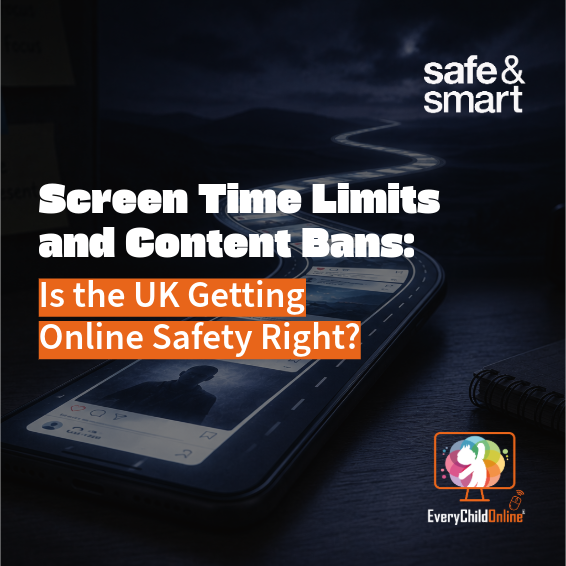
The UK government is currently discussing laws that would limit teenagers to two hours a day on social media. Their purpose is to reduce the amount of time young adults and children are spending on their devices and protect their wellbeing.
In this blog, I will be exploring the reasons behind the creation of these new laws, in addition to discussing the benefits and drawbacks of both, and explaining why I believe banning explicit material for under 18s can be a sensible step towards a safter internet experience, while rigid screen time limits may fall short of their intended impact.
Technology Secretary Peter Kyle said he is looking at a 2-hour per day limit on social media apps for young people. After about two hours on an app like TikTok or Snapchat, the platform could automatically lock the user out for the day. Officials are also discussing nighttime or school-time curfews on apps so teens can't scroll through the night or during classes. This proposal has sparked debate across education, health and parenting circles. Before discussing the benefits and potential risks of this ban being implemented, it is vital to discuss the reasons this new law is being considered. Much of this interest in reducing screen time is largely driven by growing concern over the long-term effects of excessive device use on young people's mental, physical, and social wellbeing. According to Ofcom, 19% of children ages 3-5 have their own mobile phone. UK data shows that children aged 5 to 16 now average around six hours of screen time a day, split between 2–3 hours of television, 1–3 hours online, 1–2 hours gaming, and more than an hour on mobile phones (excluding calls). With screen use now such a routine part of daily life for children, the question is no longer whether young people are online, but what the effects of so many hours in front of a screen might be? Research links heavy device use to higher rates of anxiety, depression, and even self-harm, with almost one-third of adolescents showing signs of addictive phone or social media use. Those who are most compulsive in their habits are almost twice as likely to experience suicidal thoughts compared to peers with healthier patterns.
It is also important to consider the effects of prolonged screen time on a person's physical health. Hours of sitting in front of a screen often replace opportunities for exercise, social interaction, hobbies (all of which are essential for healthy development), and more critically, disrupt healthy sleep. Late-night scrolling has become normal and is resulting in a detrimental rise in insufficient sleep. This is particularly dangerous, as a lack of sleep will eventually reduce energy levels, as well as impacting immune function, and even hormone balance. One of the key reasons for this disruption is the blue light emitted by phones, laptops, and tablets, which interferes with the body's natural sleep cycle. This blue light suppresses the hormone melatonin which, when released, signals to the brain that it is time to sleep. If melatonin is not released, the body does not enter deep, slow wave sleep (SWS) in the first half of the night. This stage of sleep is especially important: SWS is when the brain consolidates new information, moving it from short-term storage into long-term memory - missing it makes it harder to learn, concentrate, and perform well in academics or sport. Additionally, during SWS, growth hormone levels rise, and cortisol and adrenaline (stress hormones) fall. This environment helps immune cells form the body's long-term defence against pathogens. An absence of this stage of sleep means the body loses its best chance to strengthen immunity, recover, and prepare for the next day. So, when screens are used too late into the night, the processes that occur during SWS are disrupted, which leaves a person more vulnerable to illness, struggling with focus and learning, and missing out on the growth and recovery their body needs.
In the classroom, screens do not just distract; they deteriorate the ability to focus for long periods of time. I believe one of the most overlooked effects of excessive screen use is on attention span. I have personally noticed my ability to focus on schoolwork, particularly at home, has been declining over the years. Many of my friends and I have had to resort to study apps such as Flora or Study Bunny, that block the use of all other apps on a phone until a countdown has finished in order to revise or complete homework. This pattern of declining attention span is now becoming globally recognised. After checking their phones, teachers have noticed it can take up to 20 minutes for a student to refocus on classwork. This loss of focus is not just a matter of wasted time; even when phones are not actively buzzing in the classroom, the need for constant stimulation reinforced by overuse of social media and tv at home leaves many students unbale to remain concentrated for an entire lesson. Over time, this weakens essential skills such as memory, problem-solving, and the ability to engage with longer tasks like essays or projects. In this sense, excessive screen use is not only a threat to wellbeing outside of school but also a barrier to learning, reducing pupils' capacity to concentrate, retain knowledge, and achieve their full academic potential.
Although I recognise that much of this discussion suggests that we should blame the technology itself, the issue is not the devices, but the wider culture that encourages habits of excessive engagement and the convenience of staring at a screen over going outside. Platforms are designed to compete for a person's attention, and reliance on technology for almost everything in our lives - education, news, entertainment, and communication - make it difficult to switch off. In this context, bad habits aren't always choice, they're shaped by systems that reward overuse. That is why, from a government perspective, a screen time limit can seem like common sense: if excessive use is linked to such serious risks, then capping hours offers a straightforward way to reduce exposure. Still, as I will explain later, I am not convinced strict laws are the only solution, or even that they will prove sufficiently effective. What is clear however, is that there are real benefits of less time on devices. Young people should instead be encouraged to take responsibility for managing their screen habits, rather than the issue being ignored until it reaches a stage where intervention is no longer a choice but a necessity.
Looking for help with a device? Please note that Every Child Online does not provide devices directly to members of the public. *
We’d love to hear from you! Whether you’re interested in partnering with us, making a donation, or simply want to learn more about our work, please get in touch using the form.
*Every Child Online operates within the UK only. We provide support through trusted referral partners, including schools, charities, social services and community organisations. We do not supply devices directly to members of the public or outside the UK.